Diffusion: The Wave & The Medium
How Fick's Law of Particle Diffusion Became the Equation of Technology Spread
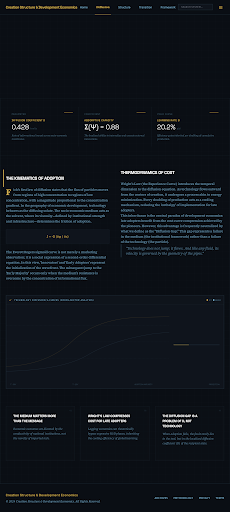
The Kinematics of Adoption
Fick's first law of diffusion states that the flux of particles moves from regions of high concentration to regions of low concentration, with a magnitude proportional to the concentration gradient. In the geography of economic development, technology behaves as the diffusing solute. The socio-economic medium acts as the solvent, where its viscosity—defined by institutional strength and infrastructure—determines the friction of adoption.
The Everett Rogers sigmoid curve is not merely a marketing observation; it is a social expression of a second-order differential equation. In this view, 'Innovators' and 'Early Adopters' represent the initialization of the wavefront. The subsequent jump to the 'Early Majority' occurs only when the medium's resistance is overcome by the concentration of informational flux.
Thermodynamics of Cost
Wright's Law (the Experience Curve) introduces the temporal dimension to the diffusion equation. As technology flows outward from the centers of creation, it undergoes a process akin to energy minimization. Every doubling of production acts as a cooling mechanism, reducing the 'enthalpy' of implementation for late adopters.
This inheritance is the central paradox of development economics: late adopters benefit from the cost-curve compression achieved by the pioneers. However, this advantage is frequently neutralized by what we define as the "Diffusion Gap." This gap represents a failure in the medium (the institutional framework) rather than a failure of the technology (the particle).
"Technology does not jump; it flows. And like any fluid, its velocity is governed by the geometry of the pipes."
T - 50Y T - 25Y ADOPTION MATURITY PROJECTION
The medium matters more than the message
Economic outcomes are dictated by the conductivity of national institutions, not the novelty of imported tech.
Read AnalysisWright's Law compresses cost for late adopters
Lagging economies can theoretically bypass expensive R&D phases, inheriting the cooling efficiency of global learning.
View DataThe diffusion gap is a problem of D, not technology
When adoption fails, the fault rarely lies in the tool, but in the localized diffusion coefficient (D) of the recipient state.
Expert ViewNext: How fractals and networks shape the architecture of spread.
Explore Structure →